


The Rising Importance of Agility Over Scale in Corrugated Converting

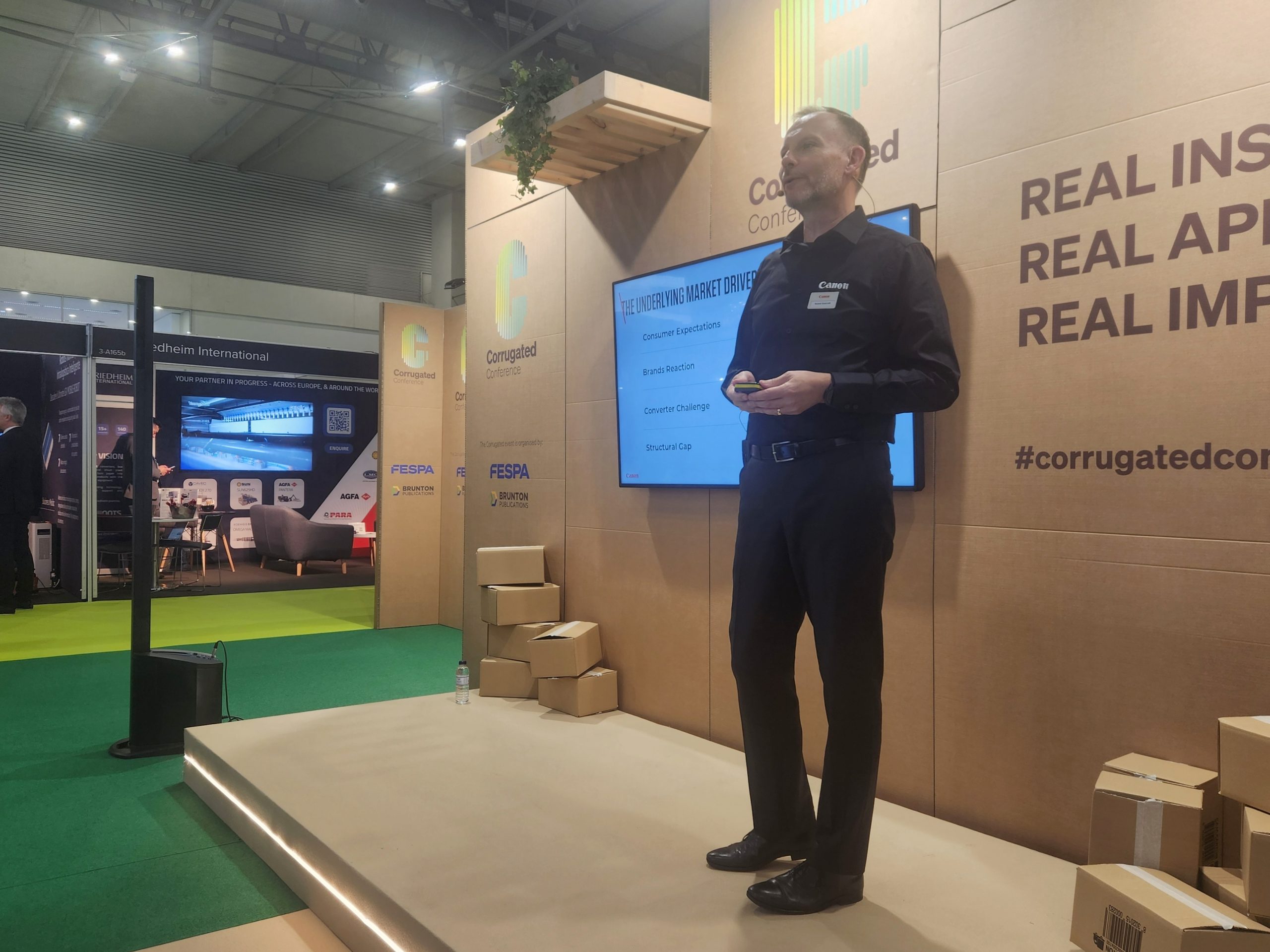
Roland Stasiczek, global business planning and strategy for industrial print, Canon
The presentation, “Agility Over Scale: How Digital Bridges Gaps in Today’s Corrugated Production,” presented by Roland Stasiczek, global business planning and strategy for industrial print, of Canon, during the Corrugated Conference held in conjunction with the 2026 FESPA Global Print Expo in Barcelona, focused on the growing mismatch between modern market demands and traditional corrugated production models. Stasiczcek shared his belief that corrugated converters must move away from purely scale-driven manufacturing. Instead, they should move toward flexible, agile production systems capable of handling volatility, customization, and shorter run lengths.
Stasiczek identified what he sees as the core driver behind market transformation: consumers. Modern consumers, he explained, expect wider product variety, faster delivery, personalization, and sustainability. These expectations create demand patterns that are “more volatile, more fragmented and less predictable.” Brands respond to these new patterns by expanding product portfolios, launching more seasonal and event-driven packaging, and increasing promotional variation. A complicated factor here, he added, is that this complexity cascades through the supply chain and leaves it up to converters to address it.
In response to this changing reality, converters must increasingly manage a larger number of packaging versions, smaller production volumes, and faster turnaround times. This must occur, he says, at a time of chronic labor shortages and skill gaps. He described this as a structural gap between current production capabilities and what the market is demanding. Traditional corrugated converters have traditionally been optimized for stable, high-volume production with a low level of complexity. But the industry is now moving into what he called a “pain zone” characterized by work that goes against the norms of the segment.
The key challenge facing converters, Stasiczek explained, is in maintaining production efficiency amid rising job complexity. He explains that, historically, converters moved toward efficiency through both scale and standardization, models he says struggle when confronted with the realities of higher SKU counts and frequent changeovers. The ideal future state, the destination he proposed, has converters managing both high complexity and strong production efficiency through hybrid manufacturing approaches and complementary technologies.
Stasiczek said digital printing is a major ingredient in this transition and compared different print technologies using three factors: cost, productivity, and quality. Conventional flexographic printing, he said, remains strong for long runs and low-cost production. Offset printing brings superior quality but at higher cost and lower flexibility. Digital printing changes the equation, by presenting the potential to balance all three factors for work requiring shorter runs.
Tying his argument to technology, he described Canon’s new corrugated digital press, the Corrugate iB17, which he says was designed to minimize compromises between quality, productivity, and cost. It supports high-speed industrial production, with print speeds of 80 linear meters per minute and calculated annual potential of approximately 15 million sq. m. for a two-shift operation, maintaining 1200dpi output at full speed.
He added that the machine was designed not only for print quality, but for operational reliability and uptime. Features including automated cleaning systems, inline quality inspection, automatic defect rejection, and advanced board handling reduce both disruptions and dependency on labor. The system also uses water-based inks and primers, is compliant with food safety standards, and aligns with rising sustainability and regulatory requirements.
One key point of Stasiczek’s presentation was that digital printing is no longer limited to very short runs. The digital production metrics and changing, and the new technology is now competitive with flexographic printing for jobs up to 20,000 sq. m. This, he said, significantly expands digital’s workable application range.
The session concluded by reinforcing the idea that the corrugated industry is undergoing a fundamental shift.
“Winners will be those aligned with market dynamics,” Stasiczek concluded, emphasizing that being flexible and responsive are factors becoming more valuable than sheer scale. He said that while digital printing alone is not the solution, getting technologies and strategies right will be essential for remaining competitive in an increasingly fragmented and fast-moving market.
- Categories:
- Business Management - Industry Trends
- People:
- Roland Stasiczek
Dan Marx, Content Director for Wide-Format Impressions, holds extensive knowledge of the graphic communications industry, resulting from his more than three decades working closely with business owners, equipment and materials developers, and thought leaders.


