


The Franken-Flow Is Costing You


There’s a term circulating among embellishment specialists for what happens when a digital print job meets an analog finishing line: Franken-flow. The monster is expensive, slow, and more common than converters want to admit.
The numbers help explain why. With 71% of label and package printers now offering digital — per the 2025 Alliance Insights report, “Digital Packaging: Maximizing Innovation and Impact” — competition on the press side has grown. Embellishment is increasingly where converters try to differentiate and protect margin.
“The label space is a space where … there’s a lot of Franken-flow when we talk about people printing digitally, but still putting those things through foil stamping that’s traditional, or screen printing, or things like that,” Kevin Abergel, president of Taktiful, says. “So, all those advantages of digital printing go out the window the second that you have to make a die or a screen.”
Meanwhile, Abergel is seeing package printers and converters use digital embellishment for shorter runs such as limited-edition products and products with many versions — which complement the short-run capabilities of digital press technology.
Innovations in Embellishment Equipment and Materials
As Sean Roberts, national director of digital embellishment solutions for industrial print at Konica Minolta, notes, embellishment has long been used in the packaging and label space. What he sees changing is the reason behind it — evolving from a nice-to-have feature to a way to protect margins — and the customer demands surrounding it.
“The idea of hot foil stamping has been around for over 100 years, and applying gloss or textures to packaging has been around for a while, but it’s been pretty cost-prohibitive at that very short, small run,” Roberts says. “So, adopting digital is not a replacement for some of the technologies that [converters] already have — because big, long runs; big, long sheets. But it allows them to go quickly to market and to be able to iterate very fast for the brands, which is really what I think we’re seeing: a big market shift of brands now wanting to say, ‘I don’t want to run 100,000 pieces. I want to run 5,000, and I want to see how they work before we change.’”
Allan Quimby, head of marketing at Kurz, agrees that digital technology and brand demands have spurred the continued growth of embellishment as a necessity, but notes that advancements in cold foil have also played a part.
“Those things have all created advantages for more places in the market to be able to use foils,” Quimby says. “And then you add the digital technology that comes along with that — well, now we can get into variable data, we can get into customization, we can get into small product runs without tooling to make it viable for someone to be able to use it.”
Roberts says Konica Minolta is supporting these shifts with its AccurioShine line, which offers converters a cost-effective entry point into digital embellishment and enables shorter runs, such as limited-edition packaging and prototypes.
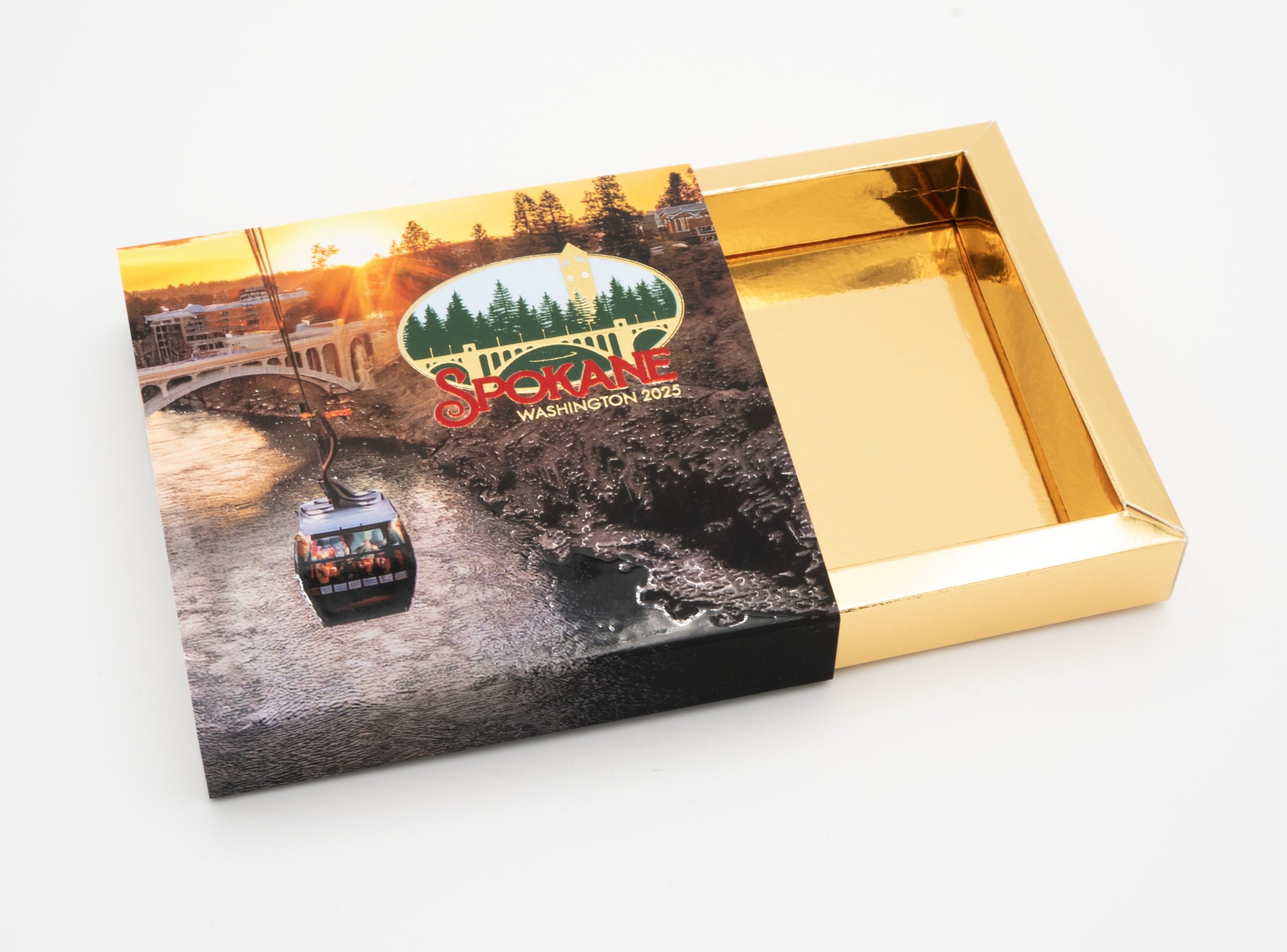
Created for the 2025 In-Plant Printing and Mailing Assocation conference, this package was embellished with Konica Minolta’s digital embellishment technology. | Credit: Konica Minolta
Aside from what brands are pushing for, Roberts has seen increased demand for integrated production and finishing — something Konica Minolta’s JetVarnish 3D Web 400 is designed to help with.
“The idea of being able to take big, 36" outer diameter, 400-lb. rolls off of one system and put them onto another system multiple times is really a productivity killer,” Roberts says. “With our Web 400, the design intent specifically was to be modular, so that it can fit into a variety of different production workflows.”
In particular, the Web 400 features in-line diecutting; can perform spot UV and hot foil in a single pass; is compatible with variable data printing; and can be configured with multiple print engines.
“Depending upon whether you’re doing a lot of spot UV and foil together on the same sheet, versus just hints of it, you can really have a fully configured unit, or something that just allows you to put particular effects and embellishments onto a label,” he says.
One of the biggest — but often unsung — developments in embellishment technology Quimby has seen recently has been a byproduct of Kurz’s sustainability efforts. Kurz, Quimby says, has sustainability baked into its DNA. The company has reduced the thickness of its polyester carrier films. Traditionally 12 microns, Kurz has taken the films down to as little as six microns, depending on the application.
“We’ve actually noticed a number of performance advantages that have occurred where you can run faster; you can get better laydown of the foils on the substrates; that your uptime can be even longer on a press because you have more running feet to a roll than you did traditionally,” Quimby says. “So, that’s been a huge win, at least for a number of our customers in that space, and they’ve seen it as an advantage.”
AI for Embellishment
Artificial intelligence (AI) is at the top of everyone’s minds, and it’s no different when it comes to label and package embellishment, where AI can play a role across the workflow.
Firstly, pricing. Print providers often struggle to determine what their customers are willing to pay for embellishments, according to Taktiful’s annually published “Digital Embellishment Study.”
“The way that we look at it is, OK, it might be good to do cost-plus [pricing] when everybody’s got one of these machines, and it’s a mature technology,” Abergel says. “But when you’ve got scarcity of supply, and there’s not one of these things on every street corner, then you have to shift to a more value-based model.”
So, Taktiful developed Taktify, which leverages both AI and individual company information — including sales data and geographic location — to help printers and converters price jobs appropriately for their market.
Abergel also sees AI — such as Taktiful’s Kreator tool, which helps designers identify where embellishments and textures can be applied on a particular design — as a way to democratize embellishment design.
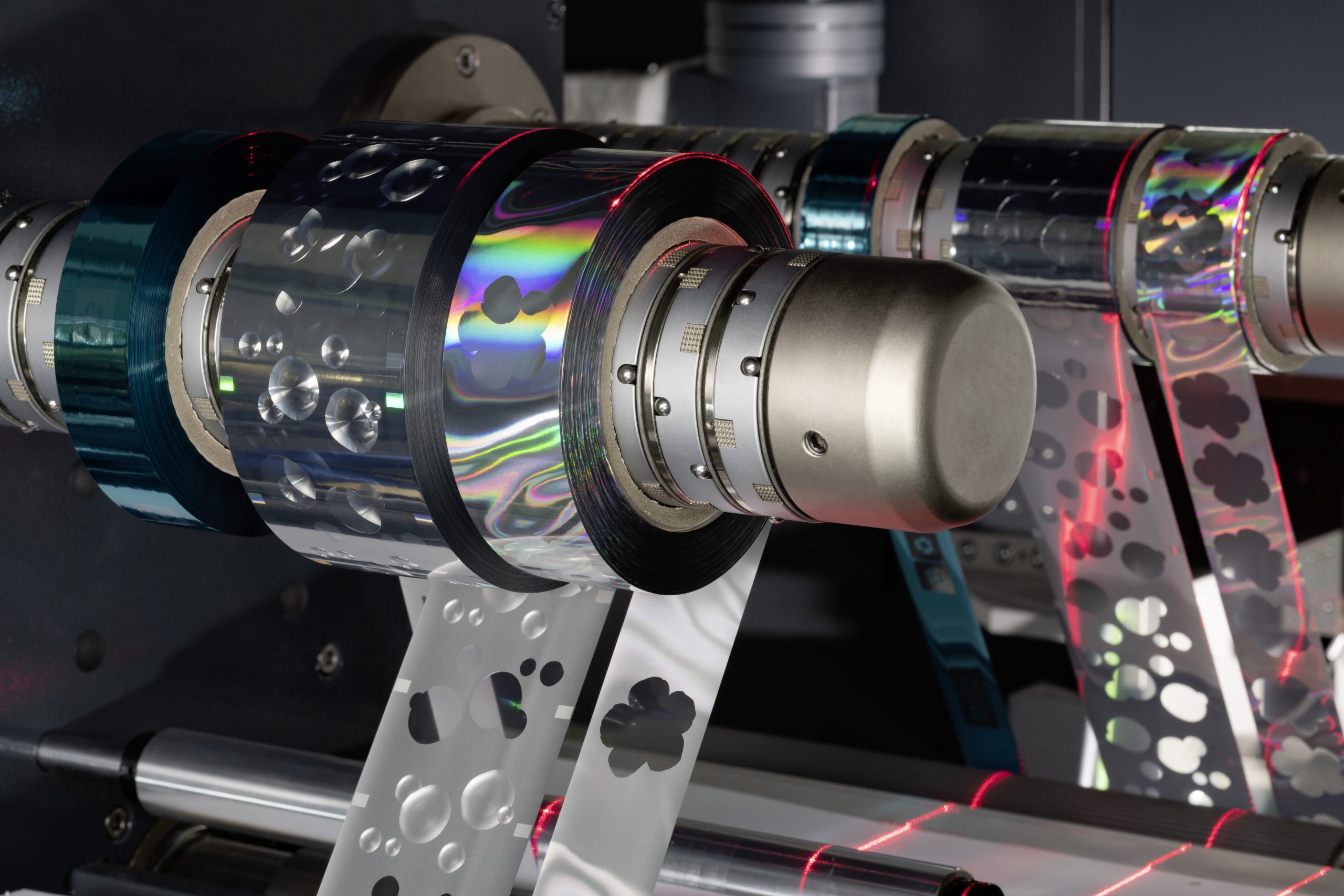
Unlike traditional cold foiling equipment, the standalone DISTORUN enables single-image applications on flexographic printing machines. | Credit: Kurz
Like Abergel, Roberts sees consideration of embellishments starting at the design stage — what he calls designing with intent — as a way to unlock greater adoption of embellishments.
“[It] happens all the time across the print community that we get all the way to the end and it’s like, ‘Oh, it doesn’t fold up correctly’ or ‘They didn’t think about this; they didn’t think about that.’ We don’t design with intent,” he says. “The same holds true in embellishments. I think when you design with intent — not as a finishing step just added to the end — that’s really where the most successful pieces come through.”
Beyond the design piece of the process, equipment manufacturers are incorporating AI to improve embellishment applications. For instance, Konica Minolta’s Web 400 features an AI smart scanner that helps ensure accurate registration.
Embellishment Outlook
One thing’s clear: embellishment is only expected to grow. Two developments Abergel sees on the horizon are faster production equipment and more B1 digital printers. He notes there are fewer digital presses available in the B1 format — a common size for packaging workflows — than digital embellishment options in that size. He predicts that having more digital B1 presses to link with digital B1 embellishment equipment will further accelerate growth.
In Roberts’ mind, increasing integration across the production process will be a big driver of growth.
“I think as workflow integration improves — with prepress tools, with different automation tools — embellishment will become a lot more predictable, it’ll become a lot more scalable, and that’s ultimately what tends to drive the broader adoption,” he says.
But will digital embellishment ever overtake traditional embellishment methods? According to Quimby, the answer is no.
“I definitely see digital as it’s going to continue to grow and evolve, but even on the conventional side, we’ve seen it continue to grow and evolve,” he says. “With cold foils, when they first came out for sheetfed applications, as an example, everyone had to run wide web, so it was one-to-one with the amount of sheets that you used. Now, they’re running narrow cuts to maximize the foil usage and minimize waste. So, all of those industries continue to evolve and to create better equipment, more efficient equipment, that’s there to support what the market demand is. So I see both of them continuing, but really excited to see next steps in both areas.”
Kalie VanDewater is senior content editor at NAPCO Media.


