


Transformative Tech, Insights Into the Brand Mind, and More From the 2025 Digital Packaging Summit

The 11th annual Digital Packaging Summit kicked off in Ponte Vedra Beach, Florida, on Monday with the opening keynote session "Outlook to 2030 and what is required to become a 'Have.'"

Conference Co-Chair Marco Boer kicks off the conference with a 2026 outlook.
As Marco Boer, conference co-chair and vice president at I.T. Strategies, noted, there's no doubt that 2025 has been a challenge.
"Of course, this year, we got hit with tariffs, and that has all kinds of unintended consequences that have a domino effect all the way through the chain to the consumer level," Boer said. "You've got these geopolitical uncertainties. There's basically no stability. Every time you think you're going in a certain direction, something else happens. And then on top of it, we've got this inflationary spiral that I believe is probably larger than what the official numbers say. So, it's complicated."
In terms of industry-specific challenges, Boer said some brands have been pulling back on their orders because they unsure of what the future will look like.
And, of course, the aging workforce causes concern. The Bureau of Labor Statistics projections for 2023 to 2033 places prepress and print finishing jobs on the list of the 20 fastest declining jobs; they're expected to drop by 18.5% and 17.5%, respectively.
But Boer said there may be a bright side to this. Many of the converters and commercial printers he's spoken to indicate that job growth may be geographically dependent — and in the packaging realm specifically, there are more young workers than the commercial world.
"So, I don't think labor is as big a problem as we had thought," Boer said. "It is a problem, but in the list of problems that we have — related to the instability of orders, rising costs, etc. — I'm going to put this really at the bottom end, at the moment. That will change."
Driven By Transformative Technologies
Boer then passed the mic to Andy Paparozzi, chief economist at PRINTING United Alliance, who dove into his positive outlook for the year to come.
First and foremost, Paparozzi sees artificial intelligence (AI) being a big driver of innovation and growth for the packaging and label industry.
"AI can enhance every mission-critical function, from prospecting to cybersecurity," Paparozzi said. "... AI allows us to automate processes we could never automate before, and every hour we save by automating some low-value, repetitive task is an hour that we can reallocate to activities that create value for our clients, for our employees, and for our company."
Also driving transformation are smart robots, which include collaborative robots (cobots) and autonomous mobile robots.
"These are powered by advances in AI, big data, powerful wireless networks, and the Internet of Things, and it's extraordinary what these things can do," Paparozzi said. "They learn as they do. They move independently. They locate, they grasp and relocate objects. They support what is called robotic process automation. That means they can conduct a range of increasingly complex activities, automating things from quality control to fulfillment to supply chain management — and you don't have to program these things. They learn how to communicate intuitively with us through voice [and] text."
Going into 2026, Paparozzi said that package and label providers will be tempted to sit and wait for clarity on what these new technologies can do for them, but the "haves" will move ahead with business plans and investments that support productivity and automation.
"The question everyone in the package and label printing industry space — without exception — should be asking is, what are we doing to make these transformative technologies an opportunity, rather than a threat?" Paparozzi said.
Paparozzi emphasized that it's not just about investing in AI and smart robotics, but about defining objectives for them at your company, staying on top of the latest developments in those spaces, and assigning responsibility for your company's adoption of this tech.
Other technology transforming the packaging and label sector is digital equipment — and that's for labels, folding carton, flexible, and corrugated alike.
"What I can tell you is that virtually every single digital printer manufacturer out there is thinking about packaging, and they are investing enormous amounts of money — hundreds of millions — to develop new digital packaging printers on your behalf," Boer said. "And so we haven't seen anything yet. The ball is rolling, it's rolling a little bit slowly, but the investment is being made to help you become more efficient and tie all of this together."
A Look Into the Brand's Mind
Then, Linda Casey, conference co-chair and editor-in-chief of Packaging Impressions, led the session "Inside the Brand Mindset Series." Joining her was Paola Appendini, global packaging innovation principal at Mars.
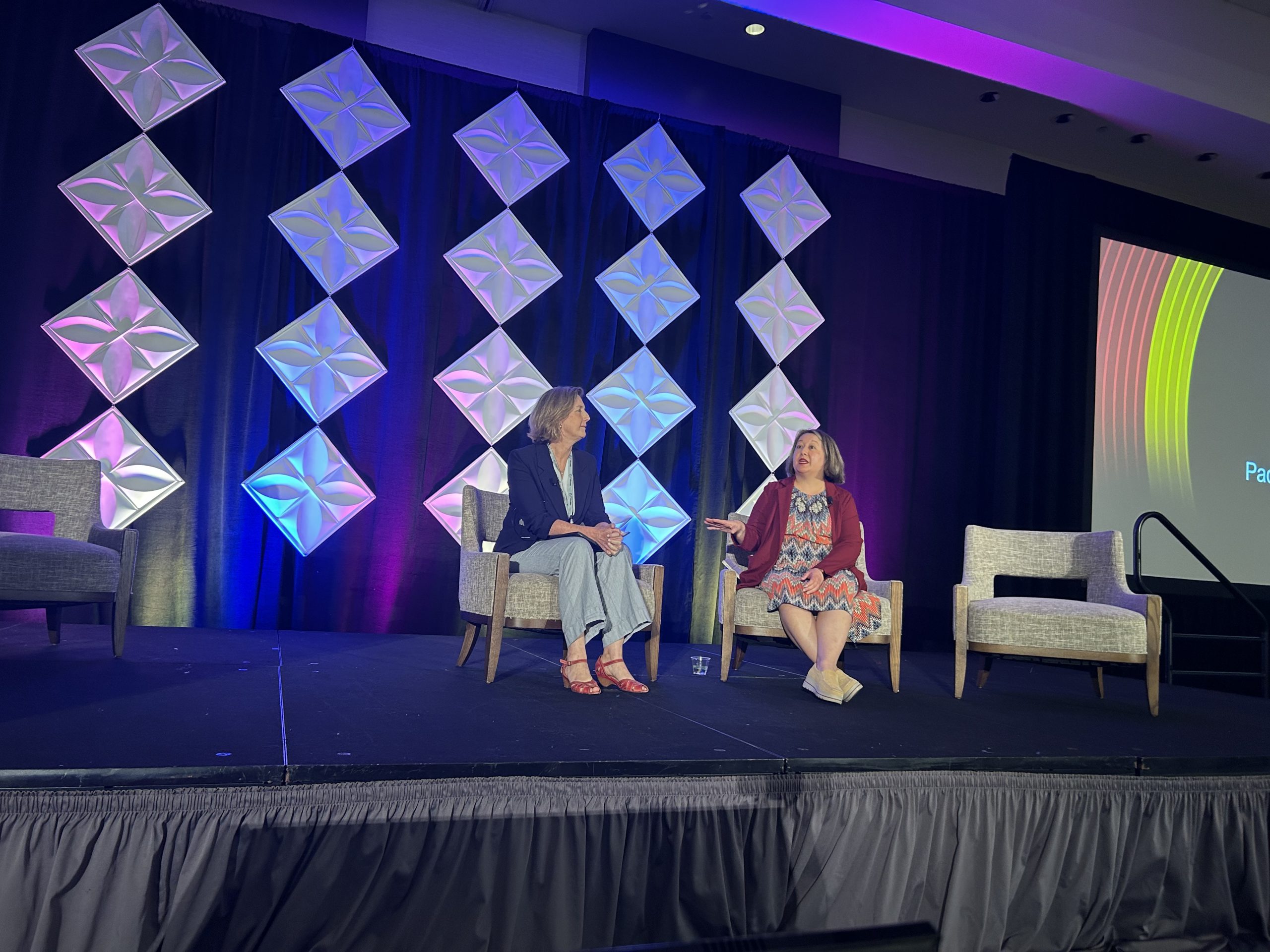
Co-chair Linda Casey (right) chats with Paola Appendini of Mars to offer perspective on brand needs.
When asked what brands look for in not just a packaging provider but a partner, Appendini said it depends, especially when considering a large brand like Mars.
"In general, from my perspective — which I'm a packaging person, right, doing the development stuff, or the global innovation stuff — I'm looking for: what's my project? What are my needs? What are the capabilities I need? If it's an innovation project, I want to have a partner that's innovative, that brings new ideas to the table," she said.
In terms of capabilities, Appendini said print quality — such as being able to hit spot colors — and speed to market are paramount.
"Obviously, speed to market is important, but the reality is that we also have very internal processes that are really slow," Appendini said. "So no matter if you bring me a printing in three days, I still need to deal with my system."
Speed to market is especially important when brands want to test new products.
"One of the things we look at is, how can we launch things to market for testing, which is very different mentality. That's where we want to use more of the e-commerce platform," Appendini said. "And that's where I think digital printing can come in, because we need to move things quickly change quickly, and so forth, and the orders we have are very small."
In terms of digital printing, Appendini said Mars has leveraged this technology for its e-commerce business, specifically for customizing packaging.
"I think the customization is huge," she said. "We keep talking about it, we have brands that live out of customizing, right? There's still the M&M's retail where you can mix and match ... But we've been looking at always expanding that. It goes back to, how do you crack the code of everything that's behind it? It's not just digital print, it's everything else as well."
For converters and printers looking to break into brand engagement, Appendini said education is key.
"So it's not even like a converter coming to me and say, 'Hey, we have this little digital print, and it can do this and it can do that,' but it's more like painting a vision of what it can do for us as a brand," she said.
Stories From the Trenches
Leading off day two, Marco Boer once again took the stage, this time moderating the panel session "Real Life User Experiences from your Peers in the Trenches." In the session, Boer picked the brains of several packaging providers who have worked with digital equipment.
DuraMark Technologies was founded as digital print house in November 2007, just before the Great Recession. Bill Bussick, president of the Westfield, Indiana, producer of safety decals and instructional labels, said that the main challenge then was "survival," but also convincing its OEM customers that digitally created labels could stand up to the elements.
The main challenge for DuraMark now stems from its 2024 acquisition of a company that uses traditional print processes. Bussick said that deciding which jobs should be done on which presses requires thought.

Marco Boer (left) moderates a panel of digital equipment users. Starting second from left, they are: Lee Pretsell, Shane Lauterbach, Bill Bussick, and Joseph Lippe.
"Looking at the acquisition that we made a year ago, what jobs are running on their presses that could run on our presses more efficiently?" Bussick said. "Because we were digital only, we were outsourcing several million dollars' worth of screen printing because we couldn't do it. So there was a natural reason for us to go out and look for that kind of technology, so that we could insource that. But conversely, now that we see a lot of the jobs that they're doing, whether it be screen or some of their wide-format digital, it just runs better on our roll-to-roll inkjets."
Lee Pretsell, worldwide vice president of healthcare and specialty at CCL, headquartered in Toronto, Ontario, Canada, added that deciding which jobs go on which equipment is not always black and white.
"I think there's some things you print in digital which are terrible, in flexo," Pretsell said. "I think this long run, short run thing is a gray area. We have [long-run] designs which actually fit better on digital, we have short-run designs that fit better on flexo."
Shane Lauterbach, president of Lauterbach Group in Sussex, Wisconsin, said that a lot of emphasis is put on gross margin or efficiency or throughput — which are important. However, Lauterbach said that utilization of time is what packaging and label providers should focus on as technology continues to evolve. In sales, for example, this could mean expanding who you talk to; in operations, this would translate as running multiple machines instead of one to take advantage different technologies.
"And in that utilization, if you're not investing in people, technology, and equipment monthly, you're losing out on so much opportunity, because as principal owner, that requires you to be disciplined in your approach," Lauterbach said. "Your profits are your profits, but the profits have to go back in the business."
Joseph Lippe, operations manager at Lewisburg Patterson's Dallas facility, agreed that people are key to achieving and maintaining success.
"The philosophy I have is, if you grow your people, your business is going to get better, right?" Lippe said. "And growing folks, and as technology continues to expand and improve, and making sure that your operators are up to speed with everything is now a new challenge that we have, a new complexity, as opposed to making plates and all that."
Retail Trends to Watch
After the panel, Linda Casey brought Joe Keenan, editor-in-chief of Total Retail, onstage for the "Retail Trends and Packaging Innovation" session, in which they covered some of today's consumer shopping trends and how they are impacting what brands want from their packaging.

Linda Casey (left) and Joe Keenan chat about retail trends.
One of the biggest trends with direct implications for packaging that Keenan's seeing is brands creating a consumer experience through incorporating radio frequency identification (RFID) in their products' packaging.
Also, e-commerce has grown substantially in recent years, but Keenan said nearly 85% of retail sales are still happening in brick-and-mortar shops. So, retailers are looking for ways to bring people into the store. For some, that means building in experiences for consumers.
"I have twin 10-year-old boys," Keenan said. "Baseball's their sport. ... There is nothing they would rather do if they have time than go into Dick's Sporting Goods and get in the batting cage, and that experience is going to bring them into Dick's Sporting Goods."
For brands, it's important to attract attention to their products when consumers are in-store for these types of experience. That's where they can lean on their packaging and label partners to help them stand out on shelf.
Day two also brought opportunities for attendees to hear success stories with digital technologies in the case study boardrooms, one-on-one meetings where attendees got to pick the brains of vendors, and a fun-filled casino night.


Kalie VanDewater is senior content editor at NAPCO Media.


