


ePac Enhances Flexibility With Investment in Fujifilm Inkjet Platform

When ePac Flexible Packaging was founded a decade ago, it signified a major change in the flexible packaging segment. With a business model centered entirely on digital printing, ePac helped usher in a new era in which flexible packaging could be produced economically in short runs and feature variable data.
Since its launch, ePac has grown into a global entity, with locations spanning North America, Europe, Asia, Africa, and Australia. The company is now also expanding its technological capabilities with the recent announcement of a partnership with Fujifilm, featuring multiple installations of the Fujifilm J Press FP790, a water-based inkjet platform for flexible packaging production. According to the companies, the partnership comprises a global rollout of J Press FP790 presses, beginning with an initial deployment in ePac’s Phoenix facility — the company’s largest at 66,000 sqft.
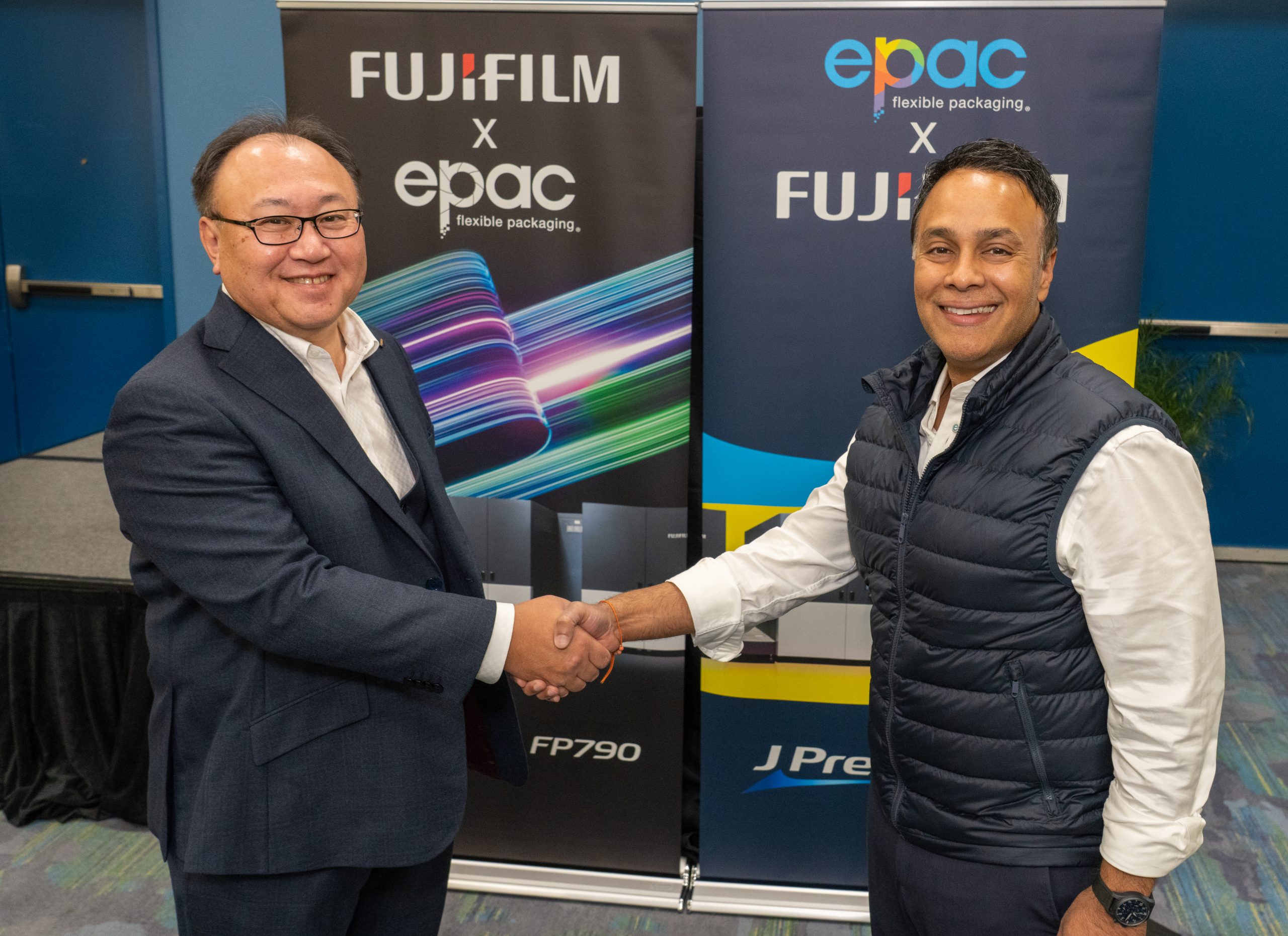
Osamu Nakashima (left), corporate VP of Fujifilm Business Innovation, and Virag Patel, CEO of ePac Flexible Packaging, celebrate their partnership. | Credit: Fujifilm
Virag Patel, CEO of ePac, said the inkjet equipment investment will allow the company to increase its production speed and run sizes, while maintaining the primary benefits of digital printing.
“The initial phase at our new Phoenix site focuses on expanding ePac’s capacity for larger run sizes which includes new markets, while maintaining the speed and agility digital printing is known for,” Patel said in a statement to Packaging Impressions. “By installing the Fujifilm J Press FP790, we are creating a true end-to-end scaling solution. The goal is to ensure that as our brand partners grow, they can scale seamlessly with ePac without needing to transition to conventional printing.”
Fujifilm will be working onsite at the ePac Phoenix location to help ensure a successful installation. In a statement to Packaging Impressions, Anthony Aquino, VP, sales, Fujifilm North America Corp., Business Innovation Division, explained that the new press will be integrated with ePac’s existing finishing processes, reducing any operational disruption.
“Our goal for the first phase of this partnership is seamless coordination, working closely onsite with ePac to get their new system installed and operational in a timely and effective manner,” Aquino said. “The goal is to enable the site to utilize its existing finishing systems to seamlessly integrate our J Press FP790 inkjet production processes without disruption to ePac’s standard operating procedures.”
Since its founding, ePac has primarily used HP Indigo equipment for its digital printing. Patel shared that the investment in inkjet equipment will provide the company with production flexibility, as each platform can bring certain advantages to various jobs. With inkjet, he said ePac can take on higher volume runs and can scale up production for customers as their businesses grow.

J Press FP790. | Credit: Fujifilm
“Primarily, it lets us handle much larger orders and longer runs digitally,” Patel said. “ePac has always helped emerging brands get started with short runs and fast turnaround. As those brands grow, from local markets to regional retailers, e-commerce and national distribution, their volumes grow too, and the FP790 means we can keep up with them at every stage.”
Though production-level inkjet is a relative newcomer to the flexible packaging industry, Fujifilm and ePac are confident in its ability to serve brand owners’ needs. Aquino shared that in addition to the personalization benefits that digital printing offers, inkjet can also enhance the sustainability attributes of flexible packaging production.
“As this market continues to evolve and the value chain continues to be enhanced by optimized design, personalized packaging, as well as lighter weight sustainable packaging, our customers (and their customers) will see that this system allows for ecofriendly production as well as print on demand capability, which delivers on the flexibility converters and brand owners are coming to not only expect, but demand,” he said.
Patel added that inkjet printing offers comparable quality to conventional processes used in flexible packaging production, assuring brand owners that they can feel at ease when shifting their packaging to digital equipment.
“On quality, inkjet handles a broad range of color and precision requirements and matches rotogravure standards, which means existing flexo artwork can move to digital without a drop in quality,” he said.
- Categories:
- Digital Printing-Inkjet Roll-to-Roll
- Companies:
- Fujifilm Graphic Systems U.S.A.
Cory Francer is Content Director for Packaging Impressions. Before that, he was an Analyst with Alliance Insights, where he led the team’s coverage of the dynamic and growing packaging market. With a decade of experience as a professional journalist and editor, Cory brings an eye for storytelling to his packaging research, providing compelling insight into the industry's most pressing business issues. He is an active participant in many of the industry's associations and has played an essential role in the development of the annual Digital Packaging Summit. Cory can be reached at cfrancer@printing.org.


