PPC's 2026 Spring Conference Highlights Paperboard Packaging Strategy, Innovation


The Paperboard Packaging Council convened in Louisville, Kentucky, last week for its 2026 Spring Outlook & Strategies Conference. The three-day event drew executives, suppliers, and brand partners from across the folding carton industry to explore the evolving landscape.
Here’s a recap of some of the event’s top highlights.
The Touch Advantage
Vicki Strull, principal at Vicki Strull Creative Collective, shared the findings of a study on the continued power of physical, tactile packaging in an increasingly digital world.
In the study, researchers tested how the look and feel of a package impacts consumers’ attitudes and purchasing habits by comparing two types of packages: those made with premium substrates and at least one embellishment, and those made with coated recycled board (CRB) and no embellishment.
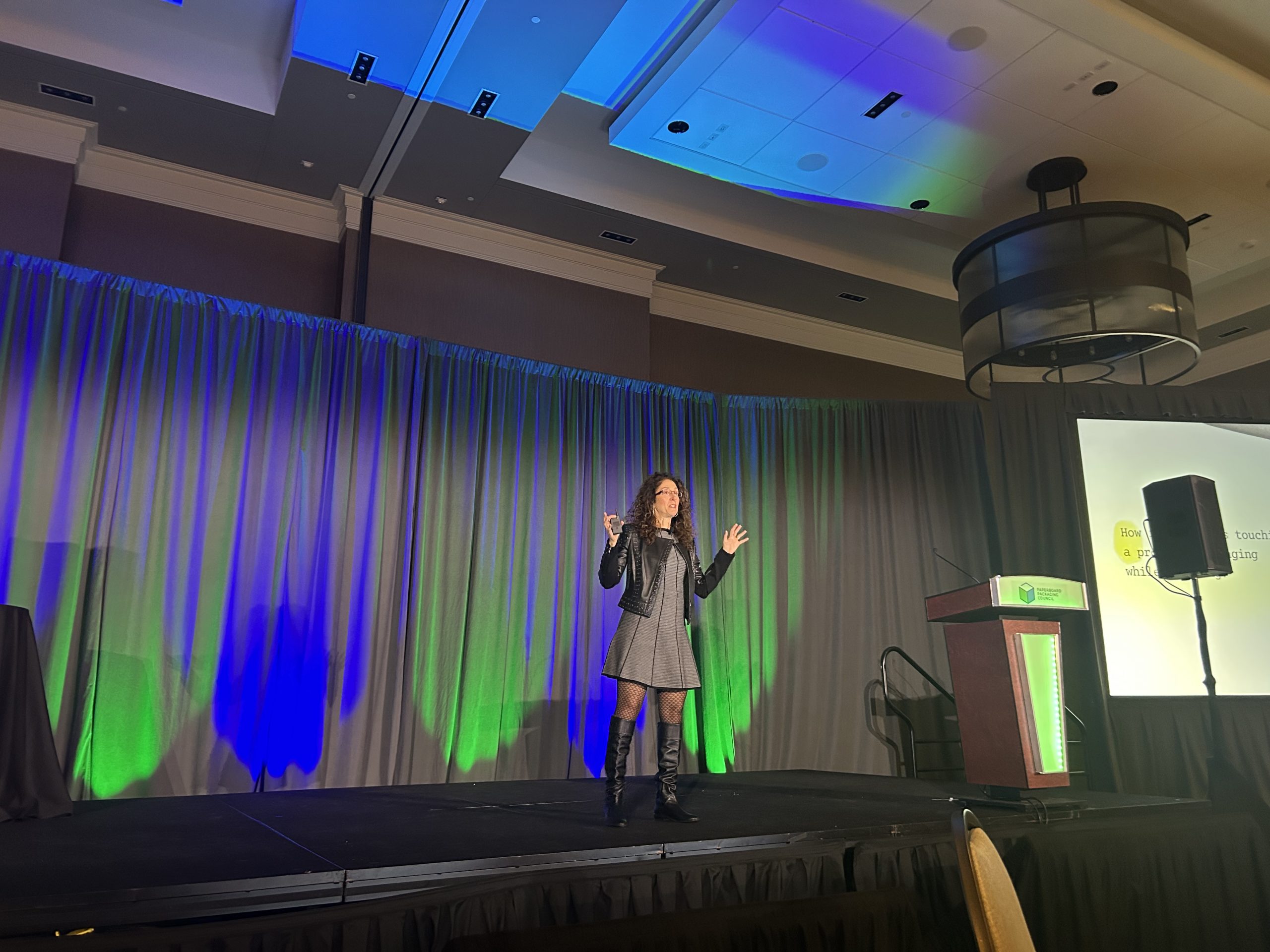
Vicki Strull talks about how touch drives sales.
One of the factors the researchers evaluated was the number of times consumers touch a package. Strull emphasized that getting people’s attention is the first step in starting a sale — but touching the package is what moves the consumer closer to actually buying the product.
“Your customer is shopping, they go in, and they see your package,” Strull said. “They touch it twice — not 10 times, not six times, twice — and it is halfway home. If they touch that premium packaging four times, they are 90% more likely to purchase it.”
The study also evaluated touch duration. On average, study participants who held a premium package for an average of 17 seconds were 50% more likely to buy a product. Strull broke that down by embellishment type: Participants were 50% more likely to purchase within 11 seconds of holding a package with gloss, 17 seconds of holding a package with foil, and 26 seconds of holding an embossed package.
Meanwhile, participants were 50% more likely to buy a plain package if they held it for 41 seconds.
Strull tied this to psychological ownership, which is the concept that touching something increases our sense of ownership. This, in turn, triggers the endowment effect, in which someone is willing to pay more for something because they feel it belongs to them.
“While capturing attention is instrumental in the decision-making process, touch is pivotal to closing the sale,” Strull stressed.
Brand Insights on Sustainability
Sustainability was the big topic of a brand owner panel featuring leaders from Nothing Bundt Cakes, The Fold Design, and the U.S. Mint, facilitated by Paul Schutes, president of the Recycled Paperboard Technical Association.
Panelists discussed how brands’ prioritization of sustainability is shifting, how packaging converters can support their goals, and where they see consumers taking a stance on sustainability.
For customers of Nothing Bundt Cakes, sustainability doesn’t seem to be a top priority, according to Courtney Chance, vice president of supply and quality assurance, who reviews customer comments. It’s worth noting, however, that nearly all of the company's packaging is paperboard, except for one plastic container.
But even within Nothing Bundt Cakes’ consumer base, there’s nuance, Chance said.
“We've also noticed that there's a little bit of a generational shift as well as it relates to sustainable packaging,” she explained. “Our core consumer of Nothing Bundt Cakes is typically a 30- to 45-year-old female, and although sustainability is important to her, it's not a top priority. Whereas some of our emerging guests who are eating cake in their cars on TikTok, it's very important to them, and they're constantly asking questions as it relates to sustainability. So, I think it's balancing for each individual brand what's important to your consumer, as well as your brand goals.”


Where do converters play a role in sustainability, then? Ben Dunlap, lead packaging planning specialist at the U.S. Mint, noted that he turns to packaging providers to flag opportunities to improve sustainability for the Mint’s product packaging.
“One of the things that I have found is that it's my supply chain that helps me identify the win-wins,” Dunlap said. “If I'm working alone, without feedback from the supply chain, I'm just stuck with my own knowledge. But if the supply chain is engaged in my product, they can help me and say, ‘Actually, just make this subtle shift — we see where you're going — change this here, and we'll get there together, and it’ll be better for us both.’”
Industry Updates
Abigail Sztein, executive director for recovered fiber at the American Forest & Paper Association (AF&PA), shared a policy update covering the association's current industry affairs priorities. This included an overview of the organization’s current litigation efforts to combat legislation with an impact on paperboard packaging.
For instance, Sztein said AF&PA has filed a lawsuit in Oregon to challenge the state’s extended producer responsibility law (EPR), arguing that there is already an effective recycling system for paper. In California, the organization joined a lawsuit challenging Senate Bill 343, the Truth in Labeling Law, which will prohibit the use of the “chasing arrows” symbol unless the product or package is verifiably recyclable. The suit outlines concerns about First Amendment rights. SB 343 is set to go into effect in October.
AF&PA is also working on several projects to advance paper recycling, including updating its “Design Guidance for Recyclability” to address common questions about how packaging design folds into recyclability.
Later, Chris Kuehl, managing director at Armada Corporate Intelligence, provided a look into the macroeconomic landscape and its implications for the packaging sector.
Concerns topping the list are tariffs and geopolitical issues. Tariffs have been unpredictable in the past year.
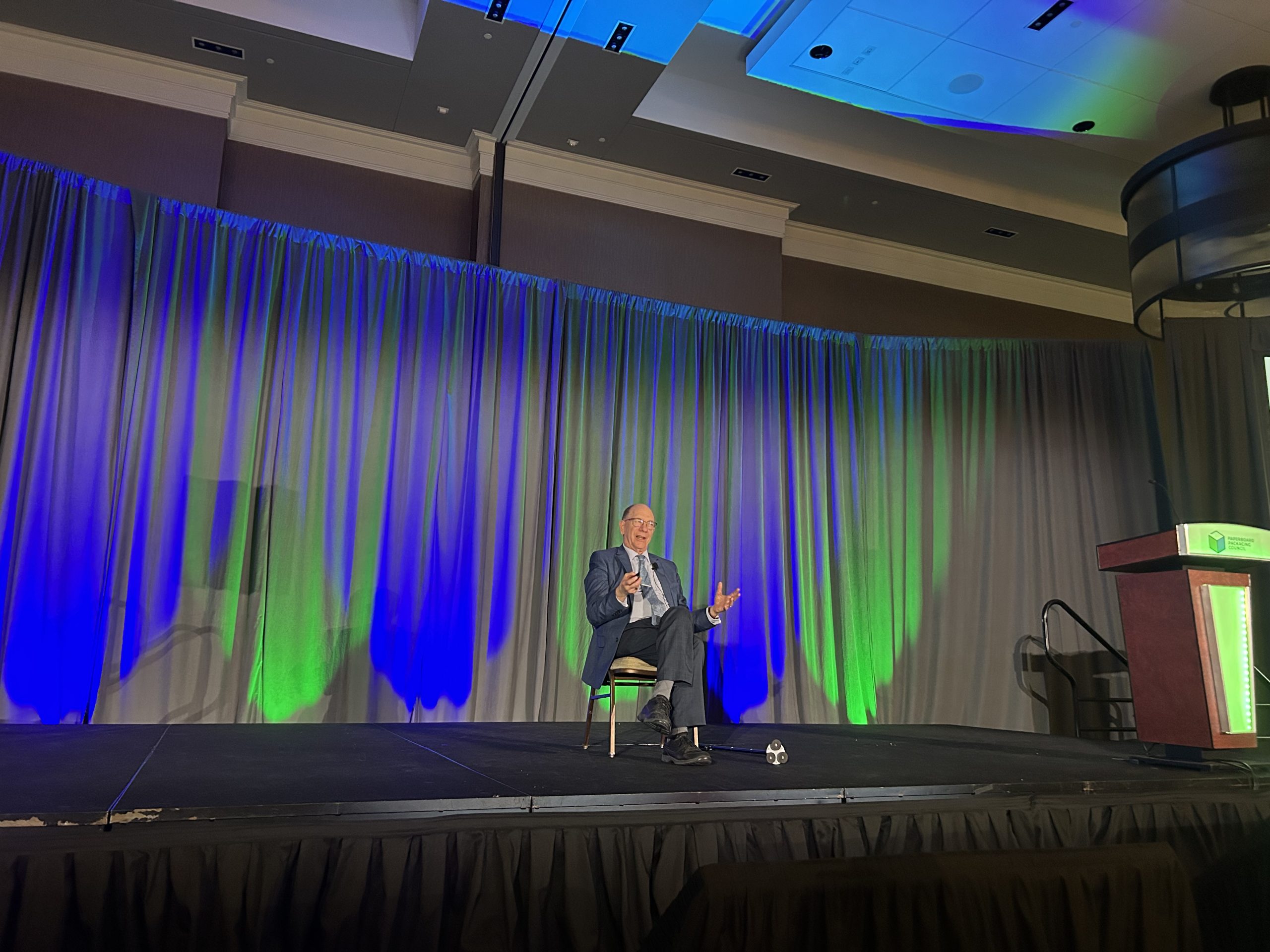
Chris Kuehl discusses the economy.
“The frustration from the business community's perspective is there's no stability,” Kuehl said. “They don't know what it's going to cost, they don't know what the input costs are going to be, they don't know how to charge for things.”
Plus, the recently begun war in Iran has put pressure on natural gas and oil transportation in the region (in 2025, the Strait of Hormuz saw an average of 20 million barrels of oil pass through it every day). The uncertainty surrounding the supply chain means costs will likely increase across the board.
Kuehl also talked about consumer spending, which drives GDP growth. Right now, we’re in what he called a “K-shaped recovery” with three distinct consumer groups:
- Those making more than $100,000, who continue to spend freely.
- Those making less than $30,000, who aren’t spending.
- Those earning $30,000-$100,000 who spend only if they feel secure in their jobs.
This means that the demand placed on packaging converters is ultimately tied to the income bracket of their customers.
Kuehl touched on several other topics, including artificial intelligence (AI), employment, and reshoring.
AI and Folding Cartons
Thursday closed out with a presentation on artificial intelligence from Gene Marks, CEO of The Marks Group, a technology consulting firm.
Marks discussed the risks inherent in AI — from job loss and security to environmental impacts — as well as the fact that generative AI has gotten smarter. He also talked about using agentic AI and use cases of various AI tools, such as augmented reality (AR) for digital twins, employee training and onboarding, and safety assessments.
Taken together, the 2026 Spring Outlook & Strategies Conference reflected an industry actively navigating change and investing in relationships and shared knowledge.
PPC's next gathering is the Folding Carton Boot Camp, scheduled for May 12-13 at its headquarters in Springfield, Massachusetts.
Kalie VanDewater is associate content and online editor at NAPCO Media.