


LOUPE Americas 2026 Spotlights Continued Innovation in Labels and Packaging

LOUPE Americas 2026, which took place Sept. 15-17 in Rosemont, IL, was a vibrant show that represented the direction the label and packaging industry is heading. The first event under the new LOUPE banner, LOUPE Americas brought together not only the label professionals seen at Labelexpos of years past, but also convened players in the flexible packaging and folding carton segments.
This convergence of segments was a major theme throughout the show. In a session on Tuesday, for instance, Steven Haedrich and David Totten shared how their companies have targeted growth beyond labels — and how other converters can too.
New York Label & Box Works in Islandia, NY — where Haedrich serves as president — has built its business around both labels and folding cartons.
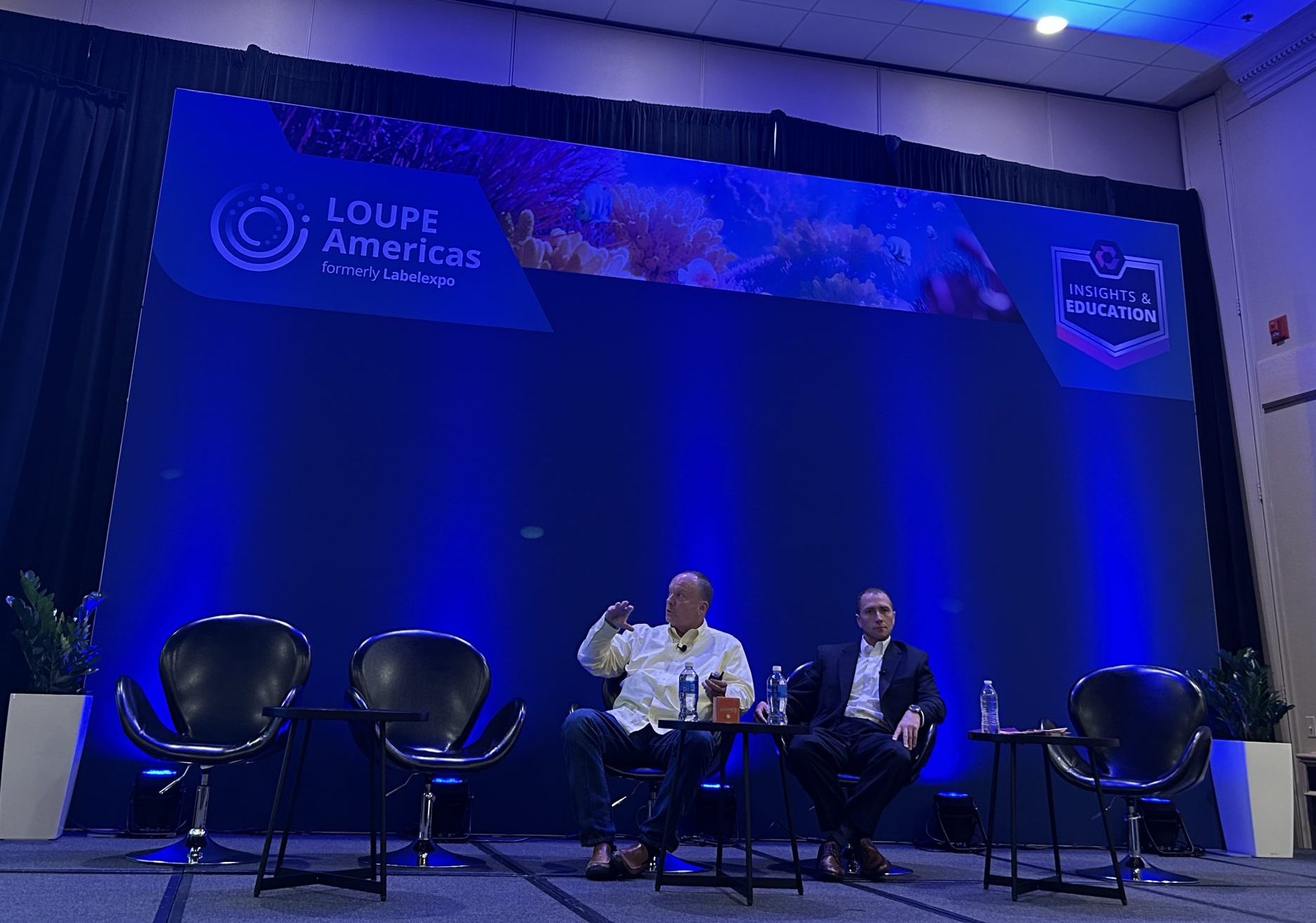
Steven Haedrich (left) and David Totten share their companies' moves beyond labels.
“What we got very good at is matching the label and carton — which before we got involved, it was oftentimes very poor,” Haedrich explained. “Our competition was one company would do the carton and one company would do the label, and they had no conversations together.”
Totten, director of innovation at Nosco, said that the company’s expansion from purely labels and pharmaceutical literature into folding cartons and flexible packaging was driven by customer interest in a “one-stop shop” experience.
“From a procurement perspective, [customers think], ‘If I only have to deal with a couple suppliers in packaging, great,’” Totten said. “So we want to be that one-stop shop.”
For printers and converters interested in these opportunities, Haedrich and Totten outlined some of the operational differences these applications present for those accustomed to label production.
When it comes to folding cartons, Haedrich said his company uses both in-line flexo and sheetfed processes, each with its own advantages. With in-line flexo, the ability to do everything at once is a huge benefit. Meanwhile, he sees sheetfed as a necessity for a large part of the market.
On the flexible packaging side, the biggest difference to keep in mind is structural — ranging from the material thickness (much thinner with flex pack) to the level of interaction with the product.
“Instead of selling a decoration or the print, you're selling a container,” Totten said. “It's a container that may have barrier properties; you need to make sure that you're going to be keeping that product free of spoilage for however many months or years that your customer is looking for. You are getting in direct contact with the product in many cases, whether you're primary or secondary, you're going to be very close to that ink, so you got to be very careful about what type of inks you're using.”
Defining Trends in Labels and Packaging
Another session focused on the driving trends over the next several years and what they require of label and packaging providers.
According to Lauren Ryder, associate principal for global packaging at Mintel, the packaging industry is facing a complicated mixture of pressures, including changing sustainability requirements, consumer demands, rising costs, and digital transformation.
“Consumers are seeking simplicity, value, and reassurance right at the exact moment where launching products is becoming more complex,” she said.

Lauren Ryder of Mintel shares an outlook for the packaging and label industry during LOUPE Americas 2026.
So, over the next two years, she anticipates packaging to be shaped by the industry’s response to three immediate pressures shaping consumer behavior.
- Consumers are suffering from what she termed a “greenwashing hangover,” meaning they care about the sustainability of their packaging, but they want proof that the packaging they interact with is actually sustainable.
- Economic challenges are pushing consumers toward different spending behaviors. Some are trading down from more premium products, while others cut back on spending in some areas so they can afford the premium products that are more meaningful to them.
- Consumers are becoming less likely to trust an organization implicitly. Organizations are needing to earn trust by being transparent, authentic, and relatable — things packaging can communicate.
Ryder expects these two-year trends to serve as the base for what the industry will be facing five years from now and beyond. Specifically, she sees connected packaging evolving from experimental to established; packaging becoming a way to help consumers stay consistent despite less predictable routines; and compliance turning into a competitive advantage.
“As regulations evolve, brands will rely on suppliers that can simplify compliance,” she said. “The organizations that can adapt packaging faster, manage data better, and navigate regulations more efficiently will gain an advantage.”
Topline Announcements at LOUPE Americas 2026
Many exhibitors displayed and unveiled technologies that will continue to push these trends forward.
For one, Konica Minolta introduced the AccurioLabel 231, a digital press designed for entry-level and mid-size label production. It targets several of the latest trends: fast run times, fewer manual touches, and high-quality output.
“What we consistently hear from customers is the need to keep presses running, reduce operator intervention, and maintain quality under demanding production conditions,” Frank Mallozzi, president of industrial and production print at Konica Minolta, said in a company release. “The AccurioLabel 231 was designed to help them do exactly that while creating more opportunities for profitable growth.”
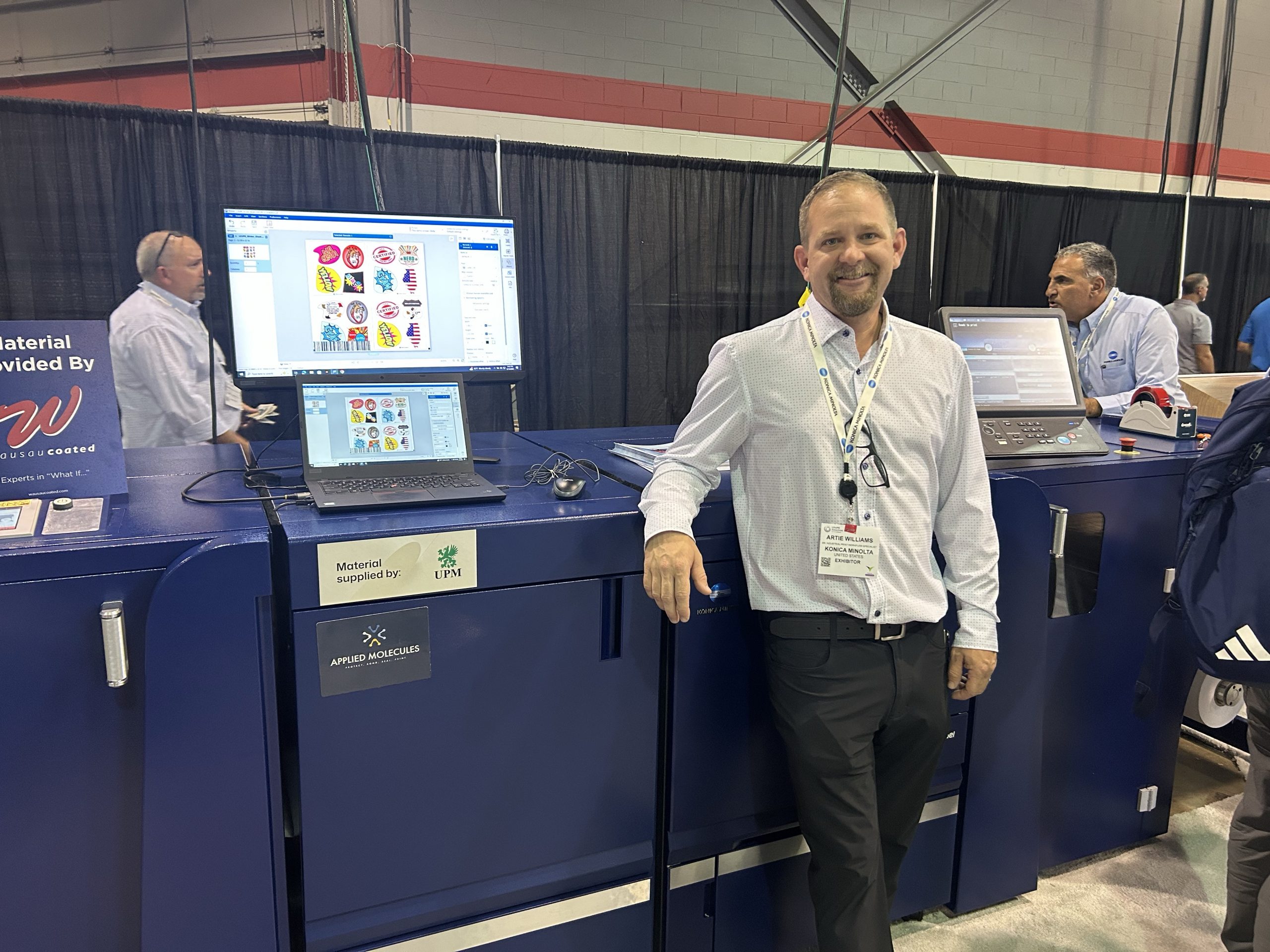
Artie Williams, senior industrial print workflow specialist at Konica Minolta, stands with the AccurioLabel 231 at LOUPE Americas 2026.
Also announced during LOUPE was Durst Group’s acquisition of MPS. The flexo printing specialist will become part of Durst effective Jan. 1, 2027, strengthening Durst’s longstanding commitment to the label and flexible packaging segments.
“Our customers need production environments that allow them to manage different applications, run lengths, and business models with maximum efficiency and flexibility,” Christoph Gamper, Durst Group’s CEO and co-owner, said in a statement. “Durst already has strong capabilities in digital printing, software and hybrid production. With MPS, we are adding further flexographic expertise, technology and engineering capabilities to the Group. This will give us additional integration options and allow us to pursue complementary development paths in parallel. It means we can innovate faster, address a broader range of customer requirements, and bring new solutions to market more quickly.”

The Tau G3 peak made its North American trade show debut at LOUPE Americas 2026.
Durst’s presence at the show also marked the North American trade show debut of the Tau G3 peak, the company’s newest digital label solution.
“We introduced the Tau G3 platform at Labelexpo in Barcelona last year,” Barry Wendell, national sales manager at Durst, told Packaging Impressions. “This is its North American debut here. Very excited about the platform, because what it is — it's a continuation of the [Fujifilm] Samba inkjet technology that we've employed in the previous platform, the RSC platform. But we've done some other modifications to the platform itself,” including more automation for easier operation.

Canon showcased the Edale LabelLine FL4p during LOUPE Americas 2026.
Additionally, Canon featured the Edale LabelLine Series as part of its broader print and packaging ecosystem, the first time the company has done so at a major U.S. industry event. Edale’s LabelLine platform can handle short, medium-length, and long runs, offering converters flexibility.
“Converters need production platforms that can adapt as quickly as their customers’ requirements change,” Lachlan Buirds, managing director of Edale, said in a press release. “The LabelLine FL4p brings flexographic printing and converting together in a highly integrated production platform, designed to help customers reduce production touchpoints and manual intervention, improve workflow efficiency, increase flexibility, and streamline short-run production, turning potential into performance.”
Some other big news at LOUPE Americas 2026 included:
- The first trade show demonstration of Visualis3R, a software solution designed to preview print embellishments accurately on a monitor without using physical proofs. The software was shown through a collaboration between Color-Logic and Screen.
- New AI capabilities backed into Infigo’s Web-to-label, Web-to-pack, and Web-to-print software. Now, converters can use the baked-in AI solutions to turn customer requests into orders quickly, create and update products in bulk, and make changes to storefronts through conversation rather than time-consuming manual configuration.
- IST America’s launch of the modular swap4cure system, combining UV, UV-LED, and thermal curing in one platform. This gives printers the flexibility to change quickly between the technologies.
- Three new changes to Amtech Software’s Label Traxx. First, Label Traxx is becoming cloud-based to improve efficiency and security. Second, Amtech Visual Analytics connects with the Label Traxx data warehouse to help converters get more value from their financial and operational performance data. Lastly, the new Track & Trace module expands the ERP’s roll control by recording length, width, location, lineal feet used, parent material, and more.
- Modularity in the form of Heidelberg and Gallus Group’s System to Compose concept, which enables flexible and scalable production configurations. Attendees also got to see demos of the newest Screeny screen printing unit for high-value label applications.
The next LOUPE Americas show will take place Sept. 12-14, 2028.
Kalie VanDewater is senior content editor at NAPCO Media.


